
No real news here. We all know that Dick Cheney will attack anyone who does not believe in sending American troops to fight and die in an unnecessary war. Something he’s all in favor for.
In an interview on ABC, Cheney spoke about fellow Republican and potential 2016 presidential candidate, Rand Paul, calling Paul an “isolationist” for his opposition to the war.
“Rand Paul … is basically an isolationist,” Cheney said on ABC’s This Week Sunday. “He [Paul] doesn’t believe we ought to be involved in that part of the world. I haven’t picked a nominee yet. But one of the things that’s right at the top of my list is whether or not the individual we nominate believes in a strong America, believes in a situation where the United States is able to provide the leadership in the world, basically, to maintain the peace and to take on the Al Qaeda types wherever they show up.”
Myrtle Beach police said Meleke Stewart, 18, and Broderick Roscoe, 18 planned to exchange sex for money with a 34-year-old man on Monday.
Alton Daniels of Shallotte, North Carolina was found dead in his car outside a Days Inn motel early Monday.
Police saw blood on his chest, and said he had been shot multiple times.
Investigators found a cellphone outside the car, and arrest affidavits said the phone contained text messages and phone calls from Stewart and Roscoe. They apparently were the last ones to talk to him before his death.
Myrtle Beach police said the two teens confessed to planning to rob Daniels. In one document, Broderick admitted to standing by while the robbery was going on.
Both men were arrested in Chester, at their own homes.
Like Dick Cheney, John Bolton was a big pusher of the original plan that led to America’s invasion of Iraq. And like Dick Cheney, Bolton now blames Obama for Iraq.
But when Bolton made a stop to the Republican safe zone of Fox News, where blaming Obama is the foundation of their very existence, Bolton found out that there is a hot seat in Rupert’s building and soon realized that he was sitting in it. Dick Cheney found himself in that very seat a few days ago.
The conversation focused on the worsening conditions in Iraq and the decision to invade in the first place. When Bolton said that past decisions are “irrelevant to the circumstances we face now,” Kelly got animated.
“I know, you keep saying that but it actually is relevant to a lot of people out there who are wondering, ‘How did we get here?’ Is it not relevant to ask, ‘How did we get here?'” she asked.
“Well, it’s very interesting, but the decision-maker has to look at the environment we have now,” Bolton responded, saying it’s for that reason he is opposed to President Obama’s plan to send 300 military advisers to Iraq.
Kelly wasn’t done talking about Bolton’s role in the military misadventure.
“You know that a lot of people are out there tonight saying, ‘Well, weren’t you one of the people who was in favor of going into Iraq in the first place and Is that why you don’t want to discuss the past ten years and whether they were worth it?'” she asked.
Bolton said he would be “happy to discuss the past 10 years and we can start 10 years before that if you want,” but he stressed that it’s “not the question that America faces today.”
Republicans continue beating the impeachment drums because the guy in the White House is actually getting things done.
The South Dakota Republican Party passed a resolution at its state convention Saturday calling for the impeachment of President Obama, according to The Sioux Falls Argus Leader.
“Therefore, be it resolved that the South Dakota Republican Party calls on our U.S. Representatives to initiate impeachment proceedings against the president of the United States,” the resolution reads.
The resolution accused Obama of violating “his oath of office in numerous ways,” and mentions the recent trade of five Taliban members for captive U.S. soldier Bowe Bergdahl, among other issues.
Delegates voted 191-176 in favor of the resolution.
“I’ve got a thick book on impeachable offenses of the president,” resolution sponsor Allen Unruh told the Argus Leader.
Spread out your morning calories for better fat-burning and faster weight loss.
Eating frequently throughout the day is nothing new. “Grazing” and “mini meals” were once all the rage for those who wanted to control hunger, lose weight, or simply eat healthier. Recently, health gurus have been encouraging a slightly different take on this approach. Now, it’s all about breakfast.
We all know breakfast is supposed to be the most important meal of the day. Drummed into our heads since we were kids, eating in the morning will jump start our metabolism and provide some much needed nourishment after a night of “fasting.” For dieters, it can be doubly important. Two breakfasts could be the key to better fat-burning and weight loss. Here’s why:
Breakfast # 1: Begin Burning Calories
Contrary to popular belief among coffee lovers, it’s carbohydrates, not caffeine, that your body needs in the morning.* Not a lot, but just enough to get you going. A small bowl of high-fiber cereal (healthy carbs) with low-fat milk (lean protein) is enough to start your engines and begin burning calories. Anything too heavy in the carb department, like a stack of pancakes, will have the opposite effect — you’ll be sent back to sleepy land once your insulin levels plummet.
Breakfast # 2: Crush the Cravings
Mid-morning food cravings are typical for everyone, especially dieters, and can lead to poor choices like a dip into the office kitchen’s donut box. The ideal second breakfast is a combination of healthy protein and high fiber to quell any hunger and encourage continued weight-loss. A turkey sausage patty on a whole grain English muffin is perfect. A smear of spicy mustard, which research suggests might increase metabolism, will boost to your body’s ability to burn fat.
Get Lean for Lunch
Eating two small healthy breakfasts will keep you happy until lunch. Too many dieters live for their lunch break, eat too quickly, and still end up unsatisfied. But if you’ve got two excellent breakfasts under your belt, your diet lunch will be a breeze to stick to and you’ll be set up for an alert and energized afternoon.
Sources:
*Pasman W et al. “Effect of two breakfasts, different in carbohydrate composition, on hunger and satiety and mood in healthy men”
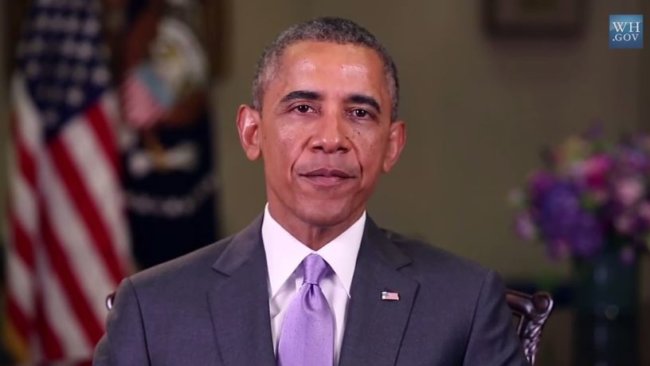
In this week’s address, the President previewed Monday’s first-ever White House Summit on Working Families where he will bring together businesses leaders and workers to discuss the challenges that working parents face every day and lift up solutions that are good for these families and American businesses. Many working families can’t afford basic needs like childcare or receive simple benefits such as paid family leave that are common in most countries around the world.
When hardworking Americans are forced to choose between work and family, America lags behind in a global economy. To stay competitive and economically successful, America needs to bring our workplace policies into the 21st century.
Even if this advertisement may seem a little bit extreme, it’s a good reminder for all of us. This video startled me out of my seat and will remind you to keep your driving safe. This shocking advert from Northern Ireland is the latest road safety campaign recently uploaded buy the DOE safety department. This video graphically depicts the amount of children that have been killed on NI roads since 2000. SHARE and give others a reminder to keep it safe on the roads. Please SHARE this and spread the awareness…
A message from Sundance festival director Stephanie Allen: “Tell the white people that it’s OK to laugh” VIDEO
The trailer for the critically acclaimed independent film “Dear White People” has arrived, and true to the film’s reviews, it is hilarious.
The movie premiered at Sundance, where, according to the movie’s director and writer Justin Simien, festival director Stephanie Allen “said that I should tell the white people that it’s OK to laugh.”
At its core, the film is about “the conflict of who you are and who you show to the world — that’s a universal situation,” he said at the Los Angeles Film Festival.
Watch the preview, below. The film hits theaters Oct. 17.
Karl Franz Williams shows off drink ingredients at his Harlem bar.
Harlem barman Karl Franz Williams hopes to open an establishment in New Haven—with the New Haven crowd as not just customers, but seed donors, as well.That was the message the 38-year old self-described “mixologist” and Yale grad sent to New Haveners in an hour-long conversation Sunday at his Harlem bar, 67 Orange Street at at 2082 Frederick Douglass Blvd. He is hoping to raise the starting funds for his new New Haven bar through “crowdfunding,” a method of gathering individual donations online from community members rather than traditional investors.
He plans to call the “Bar Philosophi” as a tribute to the city’s intellectual footprint. The bar will have drinks “inspired by conversation-inducing writers and philosophers” that will have a story, and each story a historical figure – “a writer of note,” as well as a dinner menu of “elevated food.”
He declined to give the new bar’s address since he has not yet officially signed a lease. He did say that he is looking at space in the Chapel West neighborhood.
He chose Upper Chapel, he said, because it is nearby the high-scale New Haven hotel The Study at Yale, as well as the African American Cultural Center at Yale, where he spent a good deal of time as a student.
As of Monday, Williams had raised 2 percent of his $150,000 goal from 18 donors. Williams said he prefers to start with the crowdfunding method, as it will ensure that, from the start, his bar has a connection with the New Haven community that he will serve.
What of the African presence in early China? Have there been Black people in China? If so, what became of them? What happened to the Black people of early China? Are they still there? These are profound questions. Indeed, the African presence in China is perhaps the most challenging area of research within the broad realm of the African presence in Asia. Challenging though it may be, however, it is not an area that can be dismissed. Chancellor Williams, for example, in his classicDestruction of Black Civilization, noted that:
“Ancient China and the Far East, for example, must be a special area of African research. How do we explain such a large population of Blacks in southern China, powerful enough to form a kingdom of their own?”
While in September 1998, a scientific study posted in the Los Angeles Times concluded that:
“Most of the population of modern China — one-fifth of all the people living today — owes its genetic origins to Africa.”
From the realm of the physical anthropology of early China, according to the preeminent scholar in the field, Kwan-chih Chang:
“Skeletal remains from the Hoabinhian and Bacsoinan strata, similar to those found in southwest China, bear Oceanic Negroids features.”
The first Black people in China then — the people who are probably the first of any people in China — were apparently Black people akin to the Batwa of Central Africa and the people of the Andaman Islands today — we call the Diminutive Africoids. They survived well into the historical periods. The presence of Diminutive Africoids (whom Chinese historians called Black Dwarfs) in early southern China during the period of the Three Kingdoms (ca. 250 CE) is recorded in the book of the Official of the Liang Dynasty (502-556 CE).
They are said to be Diminutive Africoids and are variously called Pygmies, Negritos and Aeta. They are found in the Philippines, northern Malaysia, Thailand, Sumatra in Indonesia and other places.
Chinese historians called them “Black dwarfs” in the Three Kingdoms period (AD 220 to AD 280) and they were still to be found in China during the Qing dynasty (1644 to 1911). In Taiwan they were called the “little Black people” and, apart from being diminutive, they were also said to be broad-nosed and dark-skinned with curly hair.
These Diminutive Africoids inhabit the Andaman Islands, a remote archipelago east of India, and are direct descendants of the first modern humans to have inhabited Asia, geneticists conclude in new studies. Their physical features, short stature, dark skin, peppercorn hair and large buttocks are characteristic of so-called African “Pygmies.” Only four of the numerous groups that once inhabited the Andamans survive, with a total population of about 500 people. These include the Jarawa, who still live in the forest, and the Onge, who have been settled there by the Indian government.
Similar groups of Black people have been identified in Japan, Vietnam, Cambodia and Indonesia, and it seems almost certain that at one time a belt of Black populations of this type covered much of Asia, including early China and especially southern China.
So there is little doubt that in the early ages of China, a Black presence was prevalent. Now what of African presence in the great civilizations of China? Ivan Van Sertima always preached that “It is one thing to say that you were first and yet another to say what you did.” So what did Africans do in ancient China? What was their status? What positions do we find them in?
Regarding the African presence in early China civilization, three dynasties in particular stand out — the Shang, the Tang and the Yuan.
The Shang Dynasty (1766-1027 BCE), China’s first dynasty, dating from the 18th to the 11th century BCE, apparently had a Black background, so much so that the conquering Zhou described them as having “Black and oily skin.” Bronze vessels, such as Le Tigresse are thus an extremely important component to our case and helps buttress our position.
Le Tigresse is by far the most spectacular of such vessels. It is a Yu vessel. In addition to Le Tigresse, in the Cernuschi Museum in Paris, there is a similar and near identical artifact in the Sumitomo Collection in Kyoto, Japan.
Le Tigresse is from the late Shang Dynasty period, about 1250 BCE. It is from Hunan Province and measures about 2 feet high. The vessel was intended to hold fermented beverages and is unquestionably the most famous and splendid object in the Cernuschi Museum. The vessel depicts a feline, a tigress with an open mouth, holding a small human in a close embrace with its front paws. For years, I had thought of the small human figure as a child. But on closer inspection, it appears that it may well be an adult. Is it a Diminutive Africoid? Whether adult or child, the features are clearly Africoid and may well be a depiction of one of the Diminutive Africoid-types associated with early China, protected in the powerful embrace of a tigress.
The entire effect is accentuated by the dark green, almost black, brilliance of the vessel, and the calm demeanor shown in the person’s face suggests an ease and confidence in its surroundings. Le Tigresse was acquired by the Cernuschi in 1920.
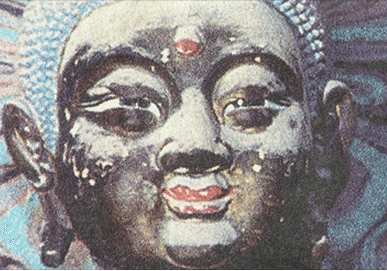
From the Tang Dynasty (618-907 CE) come statues of Africoid-looking dancers. I have photographed two such statues in both the Victoria and Albert Museum in London and the Smithsonian Museum in Washington, D.C. They have spiral hair and seem to twirl around with one arm in the air topped by clenched fist. Were these the Black dwarfs that we have read about in Chinese literature and Chinese tradition? Did they survive into the era of the Tang Dynasty?
In the Yuan Dynasty (1271-1368) founded by Kubilai Khan, the Black presence is visible in a number of notable paintings. The first of these paintings by the Yuan court artist Liu Guandao in 1280, now in the National Palace Museum in Taipei, Taiwan, is of a Mongol hunting scene. Specifically, the painting depicts two powerful looking Black men on horseback with Kubilai Khan during a hunt. Kubilai Khan was arguably the most powerful man in the world at the time and the easy posture that these men are depicted in gives one reason to think that that they are more than the Khan’s bodyguards, more than mere soldiers but quite possibly nobles or high officials of the Yuan court.
The second painting is a handscroll depicting “tribute bearers” toward the end of the Yuan Dynasty, about 1350 CE. It is housed in the Asian Art Museum, Avery Brundage Collection, San Francisco. The painting depicts four Black men, one of which is of great prominence.
What is most striking about the Shang Dynasty Yu vessels, the Tang Dynasty statues and the Yuan Dynasty paintings — all clearly Africoid — is that race and ethnicity of the people depicted are never mentioned, and if one does not see these objects for themselves you would never guess, from reviewing the relevant literature, they were Black.
Speaking of which, the famous Chinese sage, Lao-Tze (ca. 600 BCE), by tradition, was “Black in complexion.” Lao-Tze was described as “marvelous and beautiful as jasper.” Magnificent and ornate temples were erected for him, inside of which he was worshipped like a god.
Such is our brief sketch of the Black presence in early China. What I have found most interesting in my researches, including the work that I am doing on China today, is the failure, I am sure deliberate, to mention the race or ethnicity of clearly Africoid objects of art. Indeed, it seems to be even more extreme in the case of the African presence in Asia than the cover-up of the African origins of ancient Egypt. This cover-up — we must call it that — of the African presence in classical civilizations is truly a global phenomenon.
*Runoko Rashidi is a historian, writer, lecturer and researcher based in Los Angeles, California. He has written extensively on the Global African Presence and leads tours to various sites around the world. This essay is culled from his most recent work African Star over Asia: The Black Presence in the East, published by Books of Africa in 2012. His upcoming tours include the African heritage in Mexico in July 2014, the African heritage in Europe in August 2014 and Nigeria and Cameroon in December 2014. For more information write to Runoko@hotmail.com or go to www.travelwithrunoko.com
SOURCES:
Chang, Kwan-chih. The Archaeology of Ancient China. New Haven: Yale University Press, 1963.
Chi, Li. The Formation of the Chinese People: An Anthropological Inquiry. 1928; rpt. New York: Russell and Russell, 1967.
Komaroff, Linda. Gifts of the Sultan. New Haven: Los Angeles County Museum of Art, Yale University Press, 2011.
Quartly, Jules. The Taipei Times, Nov. 27, 2004.
Rogers, J.A. Sex and Race, vol. 1. St. Petersburg: Helga M. Rogers, 1968.
The Los Angeles Times, Sept. 29, 1998.
Williams, Chancellor. The Destruction of Black Civilization. Chicago: Third World Press, 1976.
We use cookies to improve your experience on our site. By agreeing to this, we can analyze browsing behavior and unique IDs on this site. Declining or revoking consent may affect certain features.
Functional
Always active
The technical storage or access is strictly necessary for the legitimate purpose of enabling the use of a specific service explicitly requested by the subscriber or user, or for the sole purpose of carrying out the transmission of a communication over an electronic communications network.
Preferences
The technical storage or access is necessary for the legitimate purpose of storing preferences that are not requested by the subscriber or user.
Statistics
The technical storage or access that is used exclusively for statistical purposes.The technical storage or access that is used exclusively for anonymous statistical purposes. Without a subpoena, voluntary compliance on the part of your Internet Service Provider, or additional records from a third party, information stored or retrieved for this purpose alone cannot usually be used to identify you.
Marketing
The technical storage or access is required to create user profiles to send advertising, or to track the user on a website or across several websites for similar marketing purposes.
To provide the best experiences, we use technologies like cookies to store and/or access device information. Consenting to these technologies will allow us to process data such as browsing behavior or unique IDs on this site. Not consenting or withdrawing consent, may adversely affect certain features and functions.