They claim they couldn’t remember the President reaching out to them in the past. I don’t know what their issue is, but Congressional Republicans seems to have a very short memory or maybe it’s just selective memory. I can remember a very recent invitation from the President, asking Republicans to come to the White House for a screening of the movie Lincoln. They all refused.
Whatever their issue is, these Republicans are now happy again, because the President is continuing his outreach program to them. After taking them to dinner last night, President Obama will be hosting a lunch today. We’ll see what they have to say about him later, after all the dinners, breakfasts and lunches are over.
Reminds me of the saying, “what have you done for me lately.” They will love you when you’re paying, but hate you when you’re not.
Following on his unusual dinner on Wednesday with a dozen Republican senators, President Obama will have a bipartisan lunch on Thursday with Representative Paul D. Ryan, the Republican chairman of the House Budget Committee, and the panel’s senior Democrat, Representative Chris Van Hollen.
Mr. Obama’s recent spate of meals and phone calls with Republicans is a new outreach strategy to work around party leaders, especially in the Republican-controlled House, who have dug in against any more budget talks. And the lunch comes as Mr. Ryan is preparing to bring a new budget plan to a vote in his committee next week.
Since Mr. Ryan’s House budget is expected to be contrary to Mr. Obama’s plan, it is unclear what might come of the luncheon parlay. Mr. Ryan, as in the past three years, is expected to propose balancing the budget by cutting projected spending only, especially for the fast-growing entitlement programs Medicare and Medicaid. Mr. Obama wants a deficit-reduction package that is a balance of spending reductions and further tax increases by closing some breaks for the wealthy and corporations.
Mr. Obama’s two-hour dinner with Republican senators at the Jefferson Hotel in Washington on Wednesday apparently covered more subjects than the budget, including immigration and gun safety legislation – two of the president’s other second-term priorities. As they left, Senators John McCain of Arizona and Tom Coburn of Oklahoma each gave waiting reporters a thumbs-up.
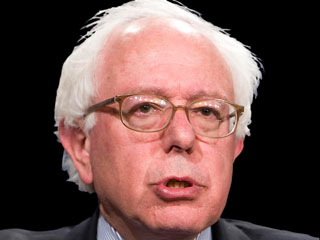
A very dramatic video of an ice sculpture forming the words, Middle Class. As we watch the symbolic melting of the middle class, we hear the voice of iconic Barnie Sanders in the background, speaking about the threats to middle class America. Senator Sanders;
There is a war going on in this country and I’m not referring to the war in Iraq or the war in Afghanistan. I’m talking about a war being waged by some of the wealthiest and most powerful people in this country against the working families of the United States of America. Against the disappearing and shrinking middle class of our country.
The reality is that many of the nation’s billionaires are on a warpath. They want more, more, more. Their greed has no end. And apparently there is very little concern for our country or for the people of this country if it gets in the way of the accumulation of more and more wealth and more and more power.
This is part of a speech Mr. Sanders gave on the Senate floor back in December 2012. He is one in a few that is brave enough to stand up and speak up on behalf of the American people. If all in Congress followed Sander’s lead and did what the people sent them there to do, America will truly be a shining beacon on a hill.
There’s a great deal to digest in these new rules, but the key to it all is how teachers are going to be evaluated, rated and either retained, let go or brought up on tenure charges for not adequately performing their jobs. Those regulations were issued separately by the DOE and are contained in this memorandum and summarized in this article.
It is here that we learn that a 50-50 split is actually a loaded proposition that is stacked against effective teaching and learning, and assumes that tests can measure how well an educator is doing their job. It is scary, and it’s coming to a school district near you in September.
All public school teachers in New Jersey will be evaluated with a system that divides their performance into two categories: 50% will be based on classroom observations and 50% will be based on student test scores or other measures of student classroom progress. The problem is that these are not equal measures. Quite simply, if all other measures are equal, the test score/student progress half will be used as the tie breaker, which effectively means that whether a teacher keeps their job is more directly related to how well their students perform on tests. I heard Commissioner of Education Christopher Cerf say it in person. I wrote it down.
I don’t think there is a single teacher who says that student achievement is irrelevant in their performance. Any teacher should be able to demonstrate that the children are learning.
The question is the evidence and how to attribute that to any one teacher. And I can say with confidence that nobody yet has figured out how to do that.
It’s a serious issue, and there are enormous stakes in us getting it right.
Classroom teachers know that they can gain very valuable information from students when they analyze scores or critical thinking assignments. Teachers can asess content knowledge, skill attainment and progress towards educational objectives. What they also know is that making these measures the tie-breaking metric is folly. You’d get more relevant data by noting which students ate an adequate breakfast the day of the test, or asked parents at drop-off how their marriages are working out, their family income, or when they last went to an AA meeting. That will tell me more about potential student performance on the day of the test than what they might have learned and retained since September.
Given that, the new state testing guidelines, courtesy of the PARCC Consortium, should make every teacher whose students will take them anticipate a shiver up the spine. Here’s what’s in store:
Third-graders, for example, now spend roughly five hours, spread over four days, on the New Jersey Assessment of Skills and Knowledge or NJ ASK tests. The new exams will take eight hours, but will be split among nine short sessions.
In Grades 4 and above, the new tests will take nine and a half hours total — over nine sessions — up from about six hours now. Some sections will take place after three-quarters of the school year is over, and other sections at the end of the year.
Think about how many days teachers and students will lose from instruction just to administer the tests. Think about the anxiety that many students will feel not only in March, but in May since the tests will be given 75% of the way through the school year and then again 90% of the way through. Then think about the disruptions in the day, because students will take these tests in short time periods, rendering much of the rest of the day’s instruction irrelevant.
Now let’s factor in the cost and availability of the computers these tests require (though there is a paper version for students whose IEPs require it). The state is recommending one computer per student. Some districts won’t have that, and can’t afford to buy more. The good news is that districts can schedule the tests in shifts so that all students can be accommodated. The bad news is that the tests will be given at all different times of the day, so possible cheating might be an issue (that one fact negates the idea that these are standardized tests). And what if some of your students don’t have sufficient enough keyboarding skills to do well on the tests? The state suggests that this will open up your district’s curriculum to teach more keyboarding. Shall we take that time away from Social Studies? Science? Physical Education? Art? We’re open to suggestions.
These tests are being hailed as ushering in a new era of education and teacher evaluation in New Jersey, but before we get ahead of ourselves, let’s remember two things:
1. The dirty secret behind the new teacher evaluation rules is that only about 20% of New Jersey’s schoolteachers will be evaluated using a standardized test, because the state has only set up tests for elementary grades in math and language arts. All other disciplines will have to come up with a classroom measure that shows student progress. Therefore, the tests will only have limited utility.
2. Standardized tests and other student progress data do not measure a teacher’s effectiveness.
The bottom line, though, is that the 50% of a teacher’s evaluation that uses tests/data will always beat out the 50% based on classroom observations. Always.
It appears the debate on Drone attacks are really beginning to heat up, but not where you’d expect. No, not internationally, but domestically… right here in the Good ol’ US of A. Now before you get all flustered and began pulling out the ‘registered’ Oozy’s you just purchased at your friendly neighborhood gun show, listen to what the Attorney General of the United States had to say.
Eric Holder
Attorney General Eric Holder said in a press conference on Tuesday that he could see Drone attacks taking place on U.S. soil one day. In fact, he said;
“It is possible, I suppose, to imagine an extraordinary circumstance in which it would be necessary and appropriate under the Constitution and applicable laws of the United States, for the President to authorize the military to use lethal force within the territory of the United States. For example, the President could conceivably have no choice but to authorize the military to use such force if necessary to protect the homeland in the circumstances of a catastrophic attack like the ones suffered on December 7, 1941, and September 11, 2001. The question you have posed is entirely hypothetical, unlikely to occur, and one we hope no President will ever have to confront.”
Rand Paul
Of course, this has riled some feathers, especially from Tea Party Extraordinaire, Rep. Rand Paul. In an interview with the beloved, Fox News, Paul stated;
“The thing about the drone strike program is we’re not talking about someone’s actively attacking America — we’re not talking about planes flying into the World Trade Center. What we’re talking about is you’re eating dinner in your house, you’re eating at a café or you’re walking down the road.”
The two instances Attorney General Holder spoke of were the most dastardly and atrocious attacks on the United States. And let’s not forget about the bombing of the Federal Building in Oklahoma that took place in April of 1995 where 168 innocent people were killed. That was a homegrown attack, cowardly planned and executed by an American. An unimaginable crime against our own people, American citizens. Americans who went to work as they always did on a seemingly, routine day. Some dropped off their kids in a daycare in the same building that was attacked. A routine, uneventful day that was just like a day in Pearl Harbor on December 7, 1941 or in New York City on September 11, 2001. They all turned out to be anything but routine.
Here’s my take.
The dynamics have changed. The game has changed. Warfare has changed. I know we are Americans and living on American soil but, as an American, don’t we and shouldn’t we have the right to live in our own country, free from fear? A fear that may one day be generated by one of our very own Citizens that have nothing but terror and terrorism in their heart, like the cowards that attacked the Federal Building in Oklahoma.
The last thing I’d want is for Drones to be used here in America, BUT, if there is a known threat to my family, friends and loved ones, “Drone the H*ll out of Them!”
This shouldn’t be a Debate. IF the public is at risk from a “known” terrorist – American or otherwise – I believe the Government, the President, the Military should use any means necessary to eliminate that threat. So, if that means drones in the United States, So Be It.
Ingredients: 1 large globe eggplant (about 1 lb), sliced crosswise into 1/4-inch thick rounds Salt 8 ounces fresh mozzarella cheese, sliced into 1/4-inch slices 1 large beefsteak tomato 1 medium red onion 10-12 fresh basil leaves About 1/4 cup olive oil 2 Tbsp red wine vinegar 2 Tbsp balsamic vinegar 6 small burger buns
Directions: 1. Line a large tray with paper towels. Lay out the rounds of eggplant on the tray in a single layer. Salt generously on both sides. Let sit while you prepare the other ingredients. 2. Cut the tomato into 1/4 inch thick slices. Cut the red onion into 1/8 inch slices. Pour the two vinegars and a teaspoon of olive oil into a flat container such as a casserole dish. Sprinkle with a little salt and stir with a fork to combine. Lay the onions and tomatoes down in the container and turn to coat with the dressing. 3. Prepare your grill for high, direct heat. Make sure the grates are clean, and close the lid. 4. Once the eggplant slices have been sitting for at least 15 minutes, pat them dry with more paper towels. Use a pastry brush to paint them on both sides with olive oil. Lay the slices on the grill and grill them for about 3-4 minutes per side with the lid closed, until nicely browned. Remove from grill. Lightly toast the burger buns on the grill, for about 30 seconds to a minute, just enough to get lightly toasted. 5. To build the sandwich, set out your burger buns. Put two or three rounds of eggplant slices on top of the bottom bun. Then add a tomato slice and some red onion. Add a couple slice of the fresh mozzarella and top it with some basil leaves.
This recipe calls for using a grill, but you could just as easily lay the eggplant slices on a broiling pan (pan rubbed first with some vegetable oil) and broil the slices a few minutes on each side.
Remember when Republicans and Mitt Romney said that the only way the economy would recover was if Mitt Romney was elected in November? Well Romney wasn’t elected and today, the stock market hit a new high – a new record.
If Romney was in office, Republicans would be praising him now as the savior. Well, I’m not going to praise President Obama as savior, but I will give him and his policies much credit for helping lift the economy out of the dungeons Bush left it in.
The benchmark Dow Jones industrial average reached an all-time high Tuesday on news that China was pledging to plow more money into its economy, returning the markets to highs not seen since before the 2008 financial crisis.
By noon Tuesday, the Dow was up more than 145 points, or 1.03 percent, to 14,273.70, blowing past both an intraday record and a closing record that were both set in October 2007, during a time when the economy was just peaking and headed toward disaster. The previous intraday trading high was 14,198.10; the closing record was 14,164.53.
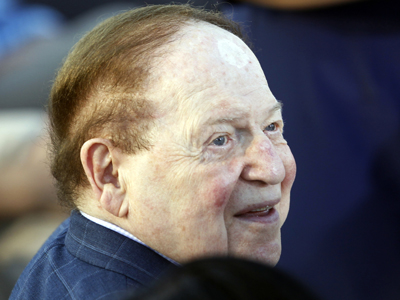
Sheldon Adelson was a heavy donor to Republican presidential candidate Mitt Romney. He really wanted Romney to win. He held fundraisers and even traveled overseas with the Republican candidate. At one point in the campaign, Adelson bragged that he would donate as much as $100 million dollars to make sure that Romney win the election.
Now we know why. Imagine if Romney had won. Sheldon Adelson would have definitely had a say in a Romney administration and could have possibly been in charge of the government department now investigating him. Imagine that!
Sheldon Adelson
The Las Vegas Sands Corporation, an international gambling empire controlled by the billionaire Sheldon G. Adelson, has informed the Securities and Exchange Commission that it likely violated a federal law against bribing foreign officials.
In its annual regulatory report, filed with the commission on Friday, the Sands reported that its audit committee and independent accountants had determined that “there were likely violations of the books and records and internal controls provisions” of the Foreign Corrupt Practices Act.
The disclosure comes amid an investigation by the Securities and Exchange Commission as well as the Department of Justice and the Federal Bureau of Investigation into the company’s business activities in China.
It is the company’s first public acknowledgment of possible wrongdoing. Ron Reese, a spokesman for the Sands, declined to comment further.
The company’s activities in mainland China, including an attempt to set up a trade center in Beijing and create a sponsored basketball team, as well as tens of millions of dollars in payments the Sands made through a Chinese intermediary, had become a focus of the federal investigation, according to reporting by The New York Times and The Wall Street Journal in August.
In its filing, the Sands said that it did not believe the findings would have material impact on its financial statements, or that they warranted revisions in its past statements. The company said that it was too early to determine whether the investigation would result in any losses. “The company is cooperating with all investigations,” the statement said.
So you’ve worked all your life trying to achieve “the American dream” and making ends meet. But of lately, it seems like no matter how hard your work (providing you have a job) and how much overtime you put in, that American dream has become an illusion and making ends meet gets more and more difficult.
Well there’s a reason for that and Republicans are playing a vital role in making sure your struggles continue.
Do you have any idea what’s really happening in this country where wealth distribution is concerned? I’m sure you think you do.
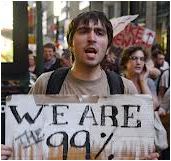
We’ve heard a lot about the top one percent and we’ve watched in amazement as Congressional Republicans defend this group while asking the rest of the country to do more with less. The top one percent are the group of people who Republicans go to bat for. They are the ones Republicans want to give more to – through service cuts and raising taxes on the poor to maintaining and creating more tax loops for the rich.
As you watch this video, keep in mind the Republican’s role in how income inequality is distributed in this country.
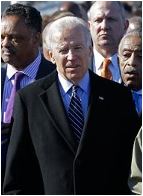
Vice President Joseph Biden today urged the Supreme Court to uphold a provision of the Voting Rights Act that gives the federal government ongoing oversight of ballot collecting in states with histories of discrimination.
Speaking at annual memorial festivities in Selma, Ala., commemorating the 1965 civil rights marchthere, the vice president told a crowd including some of those original activists, “you know it continues on today.”
“Look folks, here we are, 48 years after what you did, and we’re still fighting,” he said.
The Voting Rights Act of 1965 struck down Jim Crow segregation laws and other measures designed to impede or otherwise disenfranchise black voters. It has been renewed four times, most recently in 2006 when it passed Congress near-unanimously.
But last week conservative justices on the Supreme Court indicated they were ready to void a section of the law that requires certain states, mostly in the South, to seek federal approval for any changes to their voting regulations.
“Section Five of the Voting Rights Act in 1965, OK? I even got credit getting [Sen.] Strom Thurmond to vote for its reauthorization in the Senate,” Biden said, referring to the late, formerly segregationist lawmaker. “Strom Thurmond voted for its reauthorization in the Senate, and yet it’s being challenged in the Supreme Court of the United States of America as we stand here today.”
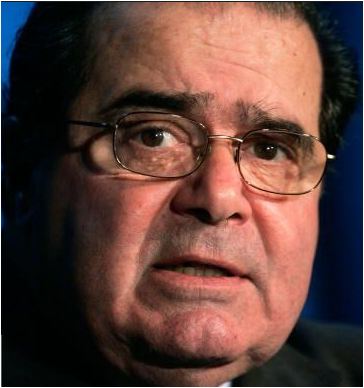
On Wednesday, Chief Justice John Roberts expressed concern that in its renewal Congress had used an outdated “coverage formula” that singled out certain states unfairly. Justice Antonin Scalia warned of “racial entitlements” that he said would prove “very difficult” to get rid of through democratic processes.
Remember last summer when the media attempted to parse the arguments and meaning of the Supreme Court’s sessions on the Affordable Care Act? Wasn’t it fun to play the “How will they vote” game? Wasn’t it extra fun when Justice Roberts played that big bad joke on Antonin Scalia and sided with the squirrely liberals?
Well, if you liked that, then you have to love last week’s arguments in the case surrounding the constitutionality of the Voting Rights Act of 1965. Here is one of the iconic laws of the civil rights era under siege from a hostile conservative majority, with the possible (probable) result that it could be overturned. But really, what’s the case all about? And what’s the fuss about comments from Justices Scalia and Roberts? if these questions burn in your soul, then you’ve come to the right place.
Here’s the recap for your edification and delight.
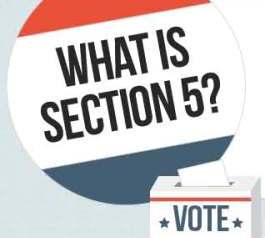
The Supreme Court will rule on whether a key part of the Voting Rights Act, Section 5, should stand. The background on Section 5 can be found here, but the basic idea is this:
Section 5 freezes election practices or procedures in certain states until the new procedures have been subjected to review, either after an administrative review by the United States Attorney General, or after a lawsuit before the United States District Court for the District of Columbia. This means that voting changes in covered jurisdictions may not be used until that review has been obtained.
Application of this formula resulted in the following states becoming, in their entirety, “covered jurisdictions”: Alabama, Alaska, Georgia, Louisiana, Mississippi, South Carolina, and Virginia, In addition, certain political subdivisions (usually counties) in four other states (Arizona, Hawaii, Idaho, and North Carolina were covered. It also provided a procedure to terminate this coverage.
Under Section 5, any change with respect to voting in a covered jurisdiction — or any political subunit within it — cannot legally be enforced unless and until the jurisdiction first obtains the requisite determination by the United States District Court for the District of Columbia or makes a submission to the Attorney General. This requires proof that the proposed voting change does not deny or abridge the right to vote on account of race, color, or membership in a language minority group. If the jurisdiction is unable to prove the absence of such discrimination, the District Court denies the requested judgment, or in the case of administrative submissions, the Attorney General objects to the change, and it remains legally unenforceable.
What this means is that none of the states listed above can make a change to its voting laws or procedures (changing polling places, hours, method of voting, and so on) without the blessing of the Justice Department. During the 1960s, when the law was passed, many states severely restricted African-American voting rights. The argument today is that almost 50 years later, those restrictions are unnecessary and burdensome.
The legal issue turns on two main parts of the act: Section Five, which covers jurisdictions with a history of discrimination, and Section Two, which covers the entire country. Both sections outlaw rules that intentionally discriminate against or otherwise disproportionately harm minority voters. Section Two would remain in effect even if the court strikes down Section Five.
But reliance only on Section Two would mean a crucial difference in how hard it may be to block a change in voting rules in an area that is currently covered by Section Five. Those jurisdictions, because of their history of discrimination, must prove that any proposed change would not make minority voters worse off.
By contrast, under Section Two, the burden of proof is on a plaintiff to demonstrate in court that a change would prevent minorities from having a fair opportunity to elect representatives of their choice.
“Getting rid of Section Five is not getting rid of voting rights; it would just make voting rights litigation look like normal lawsuits,” said Ilya Shapiro, a legal scholar at the Cato Institute, which filed a friend-of-the-court brief urging the court to strike down Section Five. “It would mean that if the federal government claims people have been harmed, it would have to prove it.”
But J. Gerald Hebert, who formerly handled voting rights litigation for the Justice Department and is now in private practice, said that losing Section Five would be “devastating to protecting voting rights” because the costs of a lawsuit are so steep. Jon Greenbaum, the legal director for the Lawyers’ Committee for Civil Rights Under Law, said it would mean that the bulk of changes that now receive automatic scrutiny by the federal government could take effect without any review, eliminating a deterrent against mischief.
In other words, under Section Five, the burden of proof is on the municipality to prove that it’s not discriminating by passing a law that affects voting. Under Section Two, the burden of proof is on the plaintiff, and they would have to foot the bill for the lawsuit. Getting rid of Section Five doesn’t mean that states can pass discriminatory laws because Section Two, which covers the whole country, would still be in effect. But like most conservative ideas, the economic and legal toll would be on those who are most likely to be affected, who are also the least likely to able to pay to defend their rights.
The case before the court comes from Shelby County, Alabama. Congress routinely re-approved the Voting Rights Act in 1970, 1975, 1982, and in 2006 extended it for 25 years. From NBC News,
Shelby County’s lawyer Bert Rein argued that Section 5 of the Voting Rights Act – which Congress renewed for another 25 years in 2006 – is unconstitutional because the formula used to determine which states are covered is outdated – based on voter turnout and registration data from 1972.
In essence, Shelby County is saying that the law is outdated, is based on obsolete information, and no longer reflects modern southern (and other) politics.
As you can see, states that can do as they please on voting laws, and only have to worry about deep-pocketed plaintiffs challenging them on Section Two, have passed the most restictve voting laws. If the Supreme Court strikes down the Act, it could lead to more Voter ID laws and the suppression of early voting laws that seem to help minority voters in the states that have them. Remember that it’s not just the south anymore. Laws that dissuade voters from voting is a national problem.
It shouldn’t surprise anyone that during oral arguments, the conservative members of the court seemed to side with Shelby County, saying that the law was outdated and, in Justice Scalia’s words,
“very likely attributable, to a phenomenon that is called perpetuation of racial entitlement. It’s been written about. Whenever a society adopts racial entitlements, it is very difficult to get out of them through the normal political processes.”
Racial entitlement.
There’s a reason that there was loud backlash against Scalia for uttering this phrase. Before there was a Voting Rights Act, wasn’t the entitlement on the side of whites? And wasn’t the remedy to make sure that all people could exercise their rights? How then did the remedy become an entitlement for African and Native Americans? All these people were asking for was the franchise. Now Justice Scalia is reclassifying them as a group that doesn’t deserve any more protections.
“He’s wrong, and in fact what’s truly disturbing is not just the doctrinaire way he presented by the assertion, but when we went searching for an data that could substantiate what he was saying, the only thing we could find was a census survey pulled from 2010 … which speaks of noncitizen blacks,” Galvin said. “We have an immigrant population of black folks and many other folks. Mississippi has no noncitizen blacks, so to reach his conclusion, you have to rely on clearly flawed information.”
By contrast, Justice Breyer referred to voting procedures as a disease, saying,
“It’s an old disease, it’s gotten a lot better, a lot better, but it’s still there,” he said. “So if you had a remedy that really helped it work, but it (discrimination) wasn’t totally over, wouldn’t you keep that remedy?”
Well, yes, but apparently, he’s in the minority.
Although it looks rather grim for keeping the Voting Rights Act intact, please do remember that it looked similar for the fate of the Affordable Care Act this time last year and we know how that worked out. Perhaps Justice Roberts or Kennedy, who also seemed hostile to upholding the Act, will change their tunes in chambers, but I don’t expect it. Given that both Florida and Ohio had significant problems with their voting procedures, and also given the love that many Republican Governors have for placing roadblocks to voting for minority communities, I could see an expansion of restrictions from the south to other parts of the country. It would then be up to individual voters to bring suits, but again, they would also have to pay for them.
One of the popular phrases that opponents of the Act use is that we’ve elected an African-American President twice, proving that we’ve turned the corner on race and voting. Very true. But the other side of the coin is that we’ve made history not only because of progress, but in spite of state laws aimed at disenfranchising minority voters who stayed in line well past poll closing time and used social media to publicize their plight. When we no longer have to worry about these shenanigans, then we won’t need the Voting Rights Act anymore. But until then, it’s clear that we still do.
Section 5 of The Voting Rights Act has become the most controversial topic in the news over the past week. And with Supreme Court Justice Antonin Scalia making unflattering comments like, I think it is attributable, very likely attributable, to a phenomenon that is called perpetuation of racial entitlement…, it puts more of a spotlight on the number one issue now facing the Supreme Court – the survivability of Section 5
Under Section 5 of the Voting Act, nine Southern states (and a few other counties) must get the advance approval from the Department of Justice in Washington for any state electoral changes they want to implement. This process, known as pre-clearance, covers everything from drawing the lines of legislative districts to deciding the location of polling places.
However, Justice Scalia thinks this very important measure amounts to Racial…Entitlement! A chance to vote… a chance which is the right of EVERY America citizens, is being considered Racial Entitlement.The comment clearly offended Justice Sonia Sotomayor. “Do you think that the right to vote is a racial entitlement in Section 5?… Do you think Section 5 was voted for because it was a racial entitlement?” she said later, seeming to call out Scalia.
Why should the fundamental right to vote, a right that was fought for and signed into law in 1965, a right that was spurred by Civil Rights Leaders, Organizers, Laymen, Preachers, Mothers and Fathers, Blacks and Whites… why is this still a topic for debate? It is so nonsensical that in 2013, the very foundation of the Voting Rights Act could possibly be overturned. And why would anyone consider overturning this important law considering what some of the GOP surrogates attempted in the election of 2012?
There were multiple reports and evidence of voter obstruction in Michigan, Pennsylvania, Texas and Florida just to name a few, where Republican governors concentrated on voter disruptions, from attempting to introduce late legislation to having voters produce picture I.D.’s to actually closing polling stations early, denying hundreds of thousands of voters an opportunity to perform there God given and Constitutional right to Vote. Those multiple disruptive behaviors alone to the voting process should be enough to keep Section 5 on the Books.
But make no mistake, this is a calculated and premeditated act of the Republican Party. Ever since President Obama was elected as President in term #1, Mitch McConnell had the audacity to state in a news conference that the main objective of his party was to “make sure this President was a one-term President.” That didn’t work out for them although they tried to block all of the President’s policies or support him in any domestic affairs that would be beneficial for the American people.
So now, after President Obama’s re-election, the scam is on. If they, the GOP and the big money bags, can’t beat him, they will attempt to swing momentum in their favor. How you asked? By changing (or stealing) the vote. By trying to eliminate Section. By cancelling out Section 5 of the Voter Rights Act. And now it appears the Republicans have found favor in a Justice on the Highest Court in the land, the Supreme Court.
So, how could a Supreme Court Justice miss this? Does he not look at the news? Does he not have access to a paper or computer with the internet? Is it just blind ignorance? I’m not sure what Scalia is thinking but I know how the majority of Americans feel.
Rep. John Lewis
Just ask Sen. John Lewis who was a part of the original marches with Dr. Martin Luther King Jr., demanding voting and civil rights for all Americans. We can also solicit feedback from Minorities, Democrats and those survivors of the Civil Rights Movement who fought to have this law passed.
Outraged! Less we forget the hundreds of thousands who were beaten, maimed, imprisoned and even killed just to perform this most important act of democracy. And to have individuals attempt to take it away is completely atrocious and un-patriotic.
A Great Big Thank You to all who paved the way for me and my family to exercise our right to vote. And Thank You to all who continue to Fight the Good Fight. This is the right of All Americans. And now we Have to take a Stand, America! Contact your Congressman and tell them, “Continue to Fight For ME so I can Vote”! Get Active, Get Busy, Get Serious America! It’s a matter of Democracy, Freedom and Justice For ALL!
This is a threat from the NRA, but based on the last election in Chicago Illinois, where one of their A+ members lost to Democratic State Representative Robin Kelly who was for gun control, it seems that this threat from the NRA amounts to just that – an empty threat. But don’t tell that to the NRA, they swear they still have the political pull they had ten or even twenty years ago.
Speaking at a rally of about 7,000 people protesting New York gun laws in Albany, Keene promised that the NRA would “soon have five million members” because of a surge of interest after lawmakers passed laws in response to the shooting of 20 elementary school children in Connecticut.
“Because of the fact that we, as believers in the Second Amendment, are willing to do something that most people in this country are not willing to do, which is not just to stand up for our rights, but to support those people who stand with us and work to get rid of those in public office who do not,” the NRA president told the crowd.
We use cookies to improve your experience on our site. By agreeing to this, we can analyze browsing behavior and unique IDs on this site. Declining or revoking consent may affect certain features.
Functional
Always active
The technical storage or access is strictly necessary for the legitimate purpose of enabling the use of a specific service explicitly requested by the subscriber or user, or for the sole purpose of carrying out the transmission of a communication over an electronic communications network.
Preferences
The technical storage or access is necessary for the legitimate purpose of storing preferences that are not requested by the subscriber or user.
Statistics
The technical storage or access that is used exclusively for statistical purposes.The technical storage or access that is used exclusively for anonymous statistical purposes. Without a subpoena, voluntary compliance on the part of your Internet Service Provider, or additional records from a third party, information stored or retrieved for this purpose alone cannot usually be used to identify you.
Marketing
The technical storage or access is required to create user profiles to send advertising, or to track the user on a website or across several websites for similar marketing purposes.
To provide the best experiences, we use technologies like cookies to store and/or access device information. Consenting to these technologies will allow us to process data such as browsing behavior or unique IDs on this site. Not consenting or withdrawing consent, may adversely affect certain features and functions.