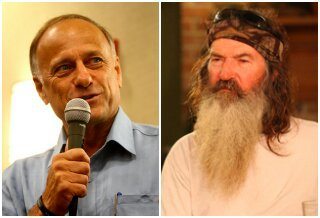
And amazingly, his comparison was made in a fund-raising email.
According to the Des Moines Register, King’s email said that the Duck Dynasty situation “illustrates the left’s unspoken rule that tolerance is a one way street. Conservatives are to be tolerant of liberal ideology; however, the left need not be tolerant of conservative Christians.”
I have been in similar situations to the one Phil Robertson finds himself in now. I have learned to navigate their intolerance while holding firm to our values. Whether it’s the Robertsons or anyone who finds themselves in the crosshairs of the media or a leftist hyperventilater sitting across the table at the local diner, employ this strategy:
Don’t back down. If you are right and you are standing on principle, whatever you do, don’t back down. The second you back down, they win.
Don’t apologize. John Wayne said, “Never apologize. It’s a sign of weakness.” I agree, unless we are wrong and we are not wrong.
Double down. Americans recognize courage and conviction. If the left attacks our conservative beliefs, I say, “If you don’t like that, here’s some more.”
Never waiver from the truth. This includes taking on all the left’s false premises before they become the perceived truth. The left is not held accountable to the truth — it is our duty to expose them. Objective truth is a shield protecting us from the left.
Tolerance has never been a two-way street with the left. Time and time again conservatives are lambasted for stating their opinions, the opinions derived from faith, family, and an understanding of history. Once again the left encourages a double standard to advance their agenda.
As you know, I have not and will not back down. And like other conservatives who stand their ground, I’m always a top target of the left.
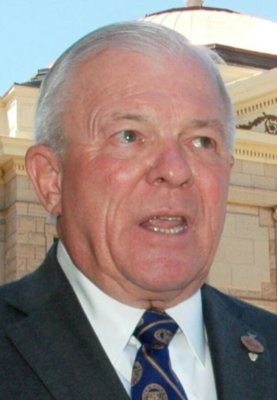
King went on to explain that with Rep. Michele Bachmann (R-MN) retiring and Col. Allen West no longer in the House, he is the “last one standing” when it comes to major conservative targets up for re-election.
Arizona Republican gubernatorial hopeful Al Melvin is using quotes from Abe Lincoln in his running fight with President Barack Obama and his policies.
The problem: The 16th president never said the things about class warfare Melvin is quoting.
For example, in postings last week on Twitter, the state senator from Tucson wrote, “You cannot further the brotherhood of man by inciting class hatred.” That quote, Melvin said, came from Lincoln.
Ditto for a quote of, “You cannot help the poor by destroying the rich,” and “You cannot strengthen the weak by weakening the strong.”
None of these came from Lincoln, Brooks Simpson, a professor of history at Arizona State University, said when asked about the quotes by Capitol Media Services.
“I can tell you that these quotes are spurious,” Simpson said. “They do not appear in Lincoln’s writings or in his recollected words.” Melvin said he got the quotes from a Republican club newsletter.
Despite near-global adulation signaled by his recognition as Time person of the year for 2013, not everyone is in raptures over Pope Francis’ attempts to rebrand the Catholic Church.
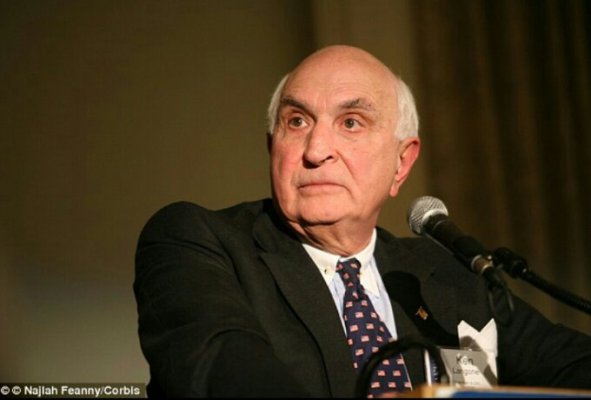
Home Depot founder Kenneth Langone, who is estimated to be worth $2.1 billion, has baulked at what he sees as hyper-critical comments aimed at the rich by the pontiff in his first published exhortation Evangelii Gaudium – fearing that he does not comprehend rich Americans.
Langone, 78, who is a devout Catholic has called the statements attributed to the pope on capitalism as ‘exclusionary’ and pointedly said that one wealthy anonymous benefactor he knows is reconsidering the seven-figure donation he wants to make to the restoration of Manhattan’s St. Patrick’s Cathedral on Fifth Avenue.
In an interview with CNBC, Langone said that the donor, who he would not name, was becoming concerned at the message the Argentinian pope was espousing – in which he urges the rich to give more to the poor and attacks a ‘culture of prosperity’ that causes some to become ‘incapable of feeling compassion for the poor’.
Langone told the network that he has personally raised his worries with Cardinal Timothy Dolan, the archbishop of New York.
‘I’ve told the cardinal, ‘Your Eminence, this is one more hurdle I hope we don’t have to deal with,’ said Langone.
‘You want to be careful about generalities. Rich people in one country don’t act the same as rich people in another country.’
Worried that the Pope does not understand wealthy American’s, Langone, who prays every morning, said that he has told Cardinal Dolan that ‘you got more with honey than vinegar’ and that he wants the archbishop to make it clear to the pope that wealthy Americans are the largest givers to charity in the world.
‘There is no nation on earth that is so forthcoming, so giving,’ he said to CNBC, adding that he hopes the pope can ‘celebrate a positive point of view rather than focusing on the negative.’
As the year ends, Gallup reports that public approval of Congress averaged 14 percent during 2013. This, the polling firm points out, is “the lowest annual average in Gallup’s history.”
The pollsters added: “2013 is the only year in Gallup’s history in which all monthly readings were below 20 percent.”
Yet this is “the new normal,” according to Gallup, because in each of the last four years the congressional approval rating for the year has been below 20 percent.
It was such a bad year for Congress that Gallup predicts the 2014 midterm elections will not, fundamentally, be a fight over which party controls the House and Senate.
Instead, the campaign could hinge on the overwhelmingly negative view of Congress and the sense “that more Americans feel that problems are with the institution itself rather than with the particular party or people who control it.”
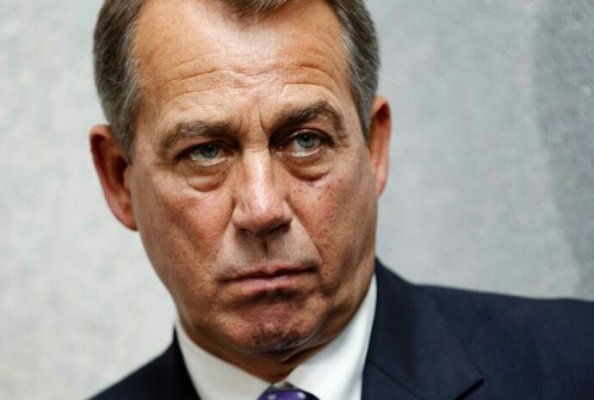
This brings us to the quote of the year about political life on Capitol Hill. It came from Speaker John Boehner (R-Ohio), defending the Republican-led House.
“We should not be judged on how many new laws we create,” he told CBS in July. “We ought to be judged on how many laws we repeal.”
This Republican strategy is at the heart of why Congress is so unpopular. They will not work on the big issues, beginning with their failure to deal with the number one public priority: creating jobs and boosting the economy.
Instead, the GOP’s congressional focus, according to the influential Republican Study Committee, is on extracting what they term “reforms” — really, they’re talking about budget cuts — in “mandatory spending” programs including food stamps, Medicare, Medicaid and Social Security. There is practically no desire for those cuts reflected in any polling.
As Campaign 2014 gets underway, Republicans are threatening another government shutdown tied to refusal to approve a debt-ceiling hike to pay bills. Their demand is for President Obama to make major cuts to programs such as Social Security.
The reduced-government, reduced-spending, reduced-federal-power strategy extends to the Senate where Republicans have used an historic number of filibusters and threats to block nominees to Obama administration posts and judicial seats. That led Senate Democrats to the “nuclear option,” opening the door to simple majority votes on most nominees.
Two suicide bombings on consecutive days killed at least 31 people in southern Russia city, highlighting the terror threat Russia faces as it prepares to host the Winter Games in six weeks.
A suicide bomber on a bus early Monday in Volgograd killed at least 14 people and left nearly 30 wounded, Russian officials said, a day after another suicide bombing killed at least 17 at a railway station in the city.
Vladimir Markin, the spokesman for Russia’s main investigative agency, said Monday’s blast involved a bomb similar to the one used in Sunday’s bombing at the city’s train station.
“That confirms the investigators’ version that the two terror attacks were linked,” Markin said in a statement. “They could have been prepared in one place.”
No one immediately claimed responsibility for the attacks, but they came several months after Chechen rebel leader Doku Umarov called for attacks against civilian targets in Russia. Umarov, leader of a terrorist group that calls itself the Caucasus Emirate, has called on Muslims to disrupt the Olympics, which will be held in Sochi in February.
“If you are a terrorist group in the Caucasus, the Sochi Olympics are going to be a very inviting target,” said Steven Pifer of the Brookings Institution’s Arms Control and Non-Proliferation Initiative.
Some Muslim terrorists view the Olympics as a provocation, says Jeffrey Mankoff of the Center for Strategic and International Studies’ Russia and Eurasia Program. Sochi was conquered in the 19th century. “They view it as a provocation on territory they consider stolen from Muslims,” he said.
It seems to be the season of making predictions for the next year, and I certainly don’t want to be the only self-appointed chronicler of the age to miss that boat, so herewith is my take on what we can expect for 2014.
The year will be unpredictable. A bold assertion, I know, but look at where we were a year ago. Obama had just been resoundingly reelected and the right was on the run. They gave in on taxes and spending and agreed to extend unemployment benefits for another year. They were talking about immigration reform and a bargain on spending. It seemed that the left had the right ideas and, led by the president, it would be a year of progress.
How did that work out? We know. Immigration passed the Senate. Sequestration clawed its way through all of the doomsday scenarios and became the budget template for the year. The House became the place where all good ideas went to die. The website was doomed to failure because nobody thought or had the money to test it. The right shut down the government. Unemployment payments have not been renewed. Our privacy either being stolen from Target or abused by the NSA.
So why am I so optimistic about the upcoming year? Because there are some terrific trends in American life that are trending in the right direction. Marriage equality is close to becoming the law of all the land. The Supreme Court will probably slow it down and rule at some point that states do have the power to prohibit it through their constitutions, but that will just be a temporary delay. State barriers to marriage, and by extension to rights for all LGBTIH and GSD and other capital letters, is in our near future. This is a profound change and one that we need to be thankful, thoughtful and diligent about enforcing.
The next year will also see health care for all. Think about that one and smile. Health care for all. The United States will join the rest of the industrialized world, and some of the less industrialized, in making sure that sickness or injury doesn’t mean bankruptcy or worse. There will be more bumps next year related to insurance company payments and recalcitrant GOP obstruction, but this law is here to stay. And the better part is that the law will be strengthened in the next few years. It has problems that need attention and we are looking at the possibility that more employers will begin moving employees to the exchanges rather than covering them through company plans. As one of my conservative friends says, if you thought the fuss over six million people being told their insurance didn’t measure up to the ACA and had their coverage canceled, wait until sixty million people who have insurance through work lose it. This is your only warning.
There are other hopeful trends to watch in 2014. The move towards a livable minimum wage is not going away and will probably gather steam next year. The criminal justice system is recognizing that mandatory sentences were a fevered reaction to inner city crime related to drugs and has done more to create a new economy based on prisons, especially in rural areas. President Obama’s sentence commutations are a first step towards making sentencing more flexible without going back to the instability of the 1960s and 70s. The Dodd-Frank bill will force financial institutions to curb or make transparent some of the practices that led to the financial crisis. Wall Street will kick and scream, but they will need to abide by the new rules.
And immigration reform will, I think find some success in the coming year. The Senate bill will not be passed by the House, and a path to citizenship might not survive the political process, but this is an idea whose time has come. It might take four or six more years before it comes to fruition, but it will.
The House will stay Republican in November and the Senate will stay Democratic, if only by 51-49 or by a Vice-President Biden Tie-Breaking Constitution Special 50-50. Someone you never considered will announce, by year’s end, that they will be a candidate for president in 2016. Someone you thought was a no-brainer will say that they will not run.
And no, it will not snow on Super Bowl Sunday.
Have a very Happy New Year and continue to work to make the United States, and the world, a better, more humane, just place to hang out in.
HONOLULU (AP) — A December surge propelled health care sign-ups through the government’s rehabilitated website past the 1 million mark, the Obama administration said Sunday, reflecting new signs of life for the problem-plagued federal insurance exchange.
Of the more than 1.1 million people now enrolled, nearly 1 million signed up in December, with the majority coming in the week before a pre-Christmas deadline for coverage to start in January. Compare that to a paltry 27,000 in October —the website’s first, error-prone month — or 137,000 in November.The figures tell only part of the story. The administration has yet to provide a December update on the 14 states running their own exchanges. While California, New York, Washington, Kentucky and Connecticut have performed well, others are still struggling.
Still, the end-of-year surge suggests that with HealthCare.Gov now functioning better, the federal market may be starting to pull its weight. The windfall comes at a critical moment for Obama’s sweeping health care law, which becomes “real” for many Americans on Jan. 1 when coverage through the exchanges and key patient protections kick in.
“As we continue our open enrollment campaign, we experienced a welcome surge in enrollment as millions of Americans seek access to affordable health care coverage,” Marilyn Tavenner, the head of the Center for Medicare and Medicaid Services, said in a blog post.
Thanks to a do nothing Congress, with blame placed squarely on the backs of the Republicans.
More than 1 million Americans are bracing for a harrowing, post-Christmas jolt as extended federal unemployment benefits come to a sudden halt this weekend, with potentially significant implications for the recovering U.S. economy. A tense political battle likely looms when Congress reconvenes in the new, midterm election year.
For families dependent on cash assistance, the end of the federal government’s “emergency unemployment compensation” will mean some difficult belt-tightening as enrollees lose their average monthly stipend of $1,166.
Jobless rates could drop, but analysts say the economy may suffer with less money for consumers to spend on everything from clothes to cars. Having let the “emergency” program expire as part of a budget deal, it’s unclear if Congress has the appetite to start it anew.
An estimated 1.3 million people will be cut off when the federally funded unemployment payments end Saturday.
Some 214,000 Californians will lose their payments, a figure expected to rise to more than a half-million by June, the Labor Department said. In the last 12 months, Californians received $4.5 billion in federal jobless benefits, much if plowed back into the local economy.
More than 127,000 New Yorkers also will be cut off this weekend. In New Jersey, 11th among states in population, 90,000 people will immediately lose out.
For many couples, the thought of living together in a 96-square-foot house sounds awful. But for Chris Derrick and Betty Ybarra, it’s a Christmas miracle.
That’s because Derrick and Ybarra have spent the better part of a year braving Madison, Wisconsin’s often-harsh climate without a roof over their head.
They’ll spend this Christmas in their own home, thanks to more than 50 volunteers with Occupy Madison, a local Wisconsin version of the original Occupy Wall Street group in New York. The group, including Derrick and Ybarra, spent the past year on an innovative and audacious plan to fight inequality in the state’s capital: build tiny homes for the homeless.
In a city where an average home for sale costs nearly $300,000, many low-income individuals simply can’t afford somewhere to live.
Indeed, in January of this year, a citywide count found 831 homeless people living in Madison, a 47 percent increase in the past 3 years. And it’s not just adults; 110 families with children were identified as well.
The “Tiny House Project” began the same month. The plan was for volunteers to build micro-homes that still include living necessities like a bed, insulation, and a toilet. The homes are heated via propane and include a pole-mounted solar panel to power the house’s light. The total cost: $3,000, paid for by private donations.
Rather than building the homes on a particular lot of land — and thus adding another expense — the houses are mounted on trailers which can be legally parked on the street, as long as they’re moved every 48 hours. Parking on the street may not even be necessary after Occupy organizers successfully convinced the Madison Common Council recently to change the city’s zoning laws so the homes could be parked on private property with permission.
As Occupy Madison continues to build more tiny houses, it hopes to eventually buy a plot of land and create a tiny village with as many as 30 homes.
Democrats have lost their advantage and Republicans now have a slight edge in the battle for control of Congress, according to a new national poll.
A CNN/ORC International survey released Thursday also indicates that President Barack Obama may be dragging down Democratic congressional candidates, and that the 2014 midterm elections are shaping up to be a low-turnout event, with only three in 10 registered voters extremely or very enthusiastic about voting next year.
Two months ago, Democrats held a 50%-42% advantage among registered voters in a generic ballot, which asked respondents to choose between a Democrat or Republican in their congressional district without identifying the candidates. That result came after congressional Republicans appeared to overplay their hand in the bitter fight over the federal government shutdown and the debt ceiling.
But the Democratic lead evaporated, and a CNN poll a month ago indicated the GOP holding a 49%-47% lead. The new survey, conducted in mid-December, indicates Republicans with a 49%-44% edge over the Democrats.
The 13-point swing over the past two months follows a political uproar over Obamacare, which included the botched rollout of HealthCare.gov and controversy over the possiblity of insurance policy cancelations due primarily to the new health law.
We use cookies to improve your experience on our site. By agreeing to this, we can analyze browsing behavior and unique IDs on this site. Declining or revoking consent may affect certain features.
Functional
Always active
The technical storage or access is strictly necessary for the legitimate purpose of enabling the use of a specific service explicitly requested by the subscriber or user, or for the sole purpose of carrying out the transmission of a communication over an electronic communications network.
Preferences
The technical storage or access is necessary for the legitimate purpose of storing preferences that are not requested by the subscriber or user.
Statistics
The technical storage or access that is used exclusively for statistical purposes.The technical storage or access that is used exclusively for anonymous statistical purposes. Without a subpoena, voluntary compliance on the part of your Internet Service Provider, or additional records from a third party, information stored or retrieved for this purpose alone cannot usually be used to identify you.
Marketing
The technical storage or access is required to create user profiles to send advertising, or to track the user on a website or across several websites for similar marketing purposes.
To provide the best experiences, we use technologies like cookies to store and/or access device information. Consenting to these technologies will allow us to process data such as browsing behavior or unique IDs on this site. Not consenting or withdrawing consent, may adversely affect certain features and functions.